
The Swarm Will Change Many Things by Dr. Timothy Smith
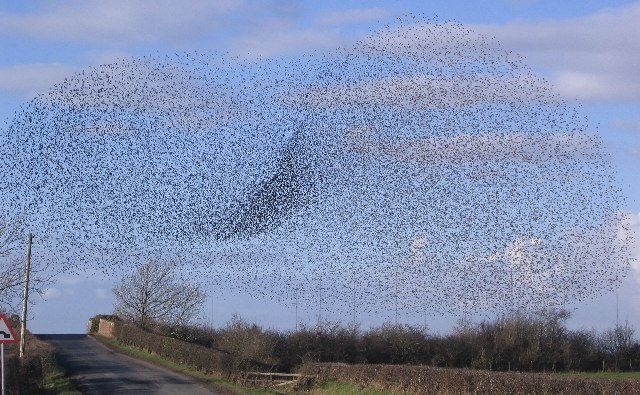
Photo Source: Wikimedia Commons
Swarm robotics powered by AI has developed significantly over the past few years, with actual applications now commercially available. The swarm operates differently from centralized command-and-control systems, such as large language models or hierarchical decision systems for robot control. A swarm consists of many small, simple robots that communicate with their neighbors, gather information from the environment, and react according to simple rules. An undulating, swooping flock of birds takes your breath away with its marvelous beauty and inexplicable choreography. It looks like it has a conductor that tells everyone exactly where to go, but the flock lacks a central leader. Instead, the individual birds, reacting to one another and the environment, move as a purposeful swarm. Swarm robotics works in the same way, and it has begun to change the landscape of many applications, including factory resupply, natural disaster response, and modern military campaigns.
Swarm robotics has altered the way factories operate and achieve efficiency. Swarm robotics from companies such as AGILOX uses swarm technology to power Autonomous Mobile Robots (AMRs) that they supply to factories and warehouses. (agilox.net) In one case, AGILOX supplied 27 AMRs to BMW's factory in Regensburg, Germany. The AMRs traverse this massive factory, which covers 15 million square feet and produces over 1,300 new cars a day. These robots carry over 2,600 tons of material a week to different stations throughout the factory, covering 2,047 miles. They do this with no central command, constant inter-robot communication, and sensors to operate safely among people and other vehicles on the factory floor.
In disaster scenarios, swarm robotics has emerged as a powerful tool for search and rescue operations where human intervention becomes dangerous or impossible. Research by T. Tanaka and colleagues at the Japan Ministry of Defense demonstrated how behavior-based swarming algorithms can control autonomous uncrewed aerial vehicles for post-disaster search and assessment (jhumanitarianaction.com). When earthquakes, floods, or building collapses occur, teams of autonomous drones and ground robots can rapidly deploy to assess damage and locate survivors. In computer simulations using actual post-disaster satellite imagery and realistic victim locations, coordinated swarms successfully situated over 90% of survivors in less than an hour.
These robotic swarms excel in disaster environments because they operate without needing a single point of control. The robots integrate collision avoidance, battery management, formation control, and various search methods to optimize coverage. Each robot makes local decisions based on simple rules and information from nearby robots, creating emergent behavior that adapts to changing conditions without constant human oversight. The emergent behavior arises from the robots' interactions, not from a prescribed set of actions or a central coordinator. The decentralized nature of these swarms proves especially valuable in unpredictable disaster zones where communication infrastructure has been destroyed. If one robot fails or loses communication, the others continue their mission seamlessly. This approach dramatically improves situational awareness during the critical first hours after a disaster when rescue efforts are most time-sensitive.
Military forces worldwide have adopted swarm robotics to transform modern warfare tactics. The ongoing war in Ukraine has accelerated the development of drone warfare, including swarm technology. According to The Wall Street Journal, Ukraine, with the help of a local technology company called Swarmer, has launched drone swarm attacks against Russian troops. In one case, a reconnaissance drone finds trenches along the Russian front and then directs armed drones to attack them with small bombs.
These swarm and drone capabilities fundamentally change the geometry of warfare. Ground-based military swarms are revolutionizing anti-armor operations, with systems like the FireAnt uncrewed ground vehicle operating in coordinated groups under a single operator. Naval forces have deployed autonomous boat swarms capable of steering and taking offensive actions independently through the Control Architecture for Robotic Agent Command and Sensing system. The Low-Cost UAV Swarming Technology (LOCUST) program can launch 30 Coyote uncrewed aerial vehicles in just 40 seconds, synchronizing them mid-flight to create attack swarms at a fraction of the cost of traditional missiles.
The swarm approach creates tactical advantages through sheer numbers and coordinated action. Having multiple micro-drones conducting surveillance is tactically advantageous because they are easier to maneuver around air defense systems than a single large drone. Beyond direct combat, swarm technology enhances logistics and security operations by providing persistent, autonomous monitoring of supply convoys and perimeters, enabling military units to maintain security with fewer personnel while freeing human operators to focus on critical decision-making. As swarm technology continues to advance, these coordinated robotic systems promise to reshape industrial processes, humanitarian response, and military operations, offering unprecedented capabilities through the power of decentralized, collaborative intelligence.

Dr. Smith’s career in scientific and information research spans the areas of bioinformatics, artificial intelligence, toxicology, and chemistry. He has published a number of peer-reviewed scientific papers. He has worked over the past seventeen years developing advanced analytics, machine learning, and knowledge management tools to enable research and support high-level decision making. Tim completed his Ph.D. in Toxicology at Cornell University and a Bachelor of Science in chemistry from the University of Washington.
You can buy his book on Amazon in paperback and in kindle format here.

Comments